Most risk teams treat chargebacks as a loss accounting problem: track them, dispute what you can, write off the rest, report the rate to leadership. The operational workflow ends when the chargeback resolves. What does not happen often enough is wiring the resolved chargeback back into the risk model as a training signal.
This matters because a confirmed fraud chargeback is exactly what a labeled training example looks like. You have a transaction that went through, a risk score that was assigned, and a confirmed outcome: this was fraud. The model scored it low and let it through. That is a false negative. Understanding which features drove a low score on a transaction that turned out to be fraud is how you improve the model's recall on that attack pattern.
The mechanics of making this feedback loop work are less obvious than they sound, and there are a few ways to do it wrong that create more problems than they solve.
The label quality problem
Not all chargebacks are equal as training labels. There are at least three categories you need to separate before using chargeback data for model training:
Confirmed third-party fraud chargebacks. These are the cleanest labels. The card was compromised, an unauthorized person made the transaction, the real cardholder disputed it, and the issuer confirmed unauthorized use. Reason codes like Visa 10.4 (Other Fraud: Card-Absent Environment) or Mastercard 4853 (Cardholder Dispute) in the context of confirmed compromised accounts are good signals. These map cleanly to "this transaction was fraud."
First-party fraud chargebacks. As discussed in our earlier post, these are cases where the account holder made the transaction and disputed it anyway. Using these as positive fraud labels for third-party fraud detection is wrong. The behavioral features of a first-party fraud transaction look legitimate because the legitimate account holder made it. Training on these as third-party fraud will teach the model the wrong thing.
Legitimate dispute chargebacks. Not delivered, goods not as described, duplicate charge. These are real disputes where the customer is correct but the transaction was not fraudulent. Including these in fraud training data degrades label quality.
The implication is that you need a classification step on your chargeback intake before you use any of it for model training. At minimum: separate by reason code and confirm the chargeback type before assigning a label. This takes work, but using unclassified chargeback data as a fraud training signal is worse than using no data at all because it degrades model precision.
The lag problem and why it matters more than you think
Chargeback confirmation takes time. A transaction happens on a Tuesday. The cardholder notices an unfamiliar charge two weeks later, files a dispute, the issuer investigates and confirms fraud, the chargeback is processed. By the time you have a confirmed label, four to six weeks may have passed since the original transaction.
For a behavioral model that is scoring transactions in real time, a six-week label lag has significant practical consequences. The attack pattern that generated the fraud may have adapted or ended by the time you incorporate the new labeled examples. The accounts involved may already be closed. The device fingerprints and IP patterns may already be flagged from other sources.
There are two ways to handle this. The more common approach is batch retraining on a rolling window: collect confirmed chargebacks, add them to the training set, retrain the model on a weekly or monthly schedule. This works but means your model is always responding to attacks that happened weeks ago.
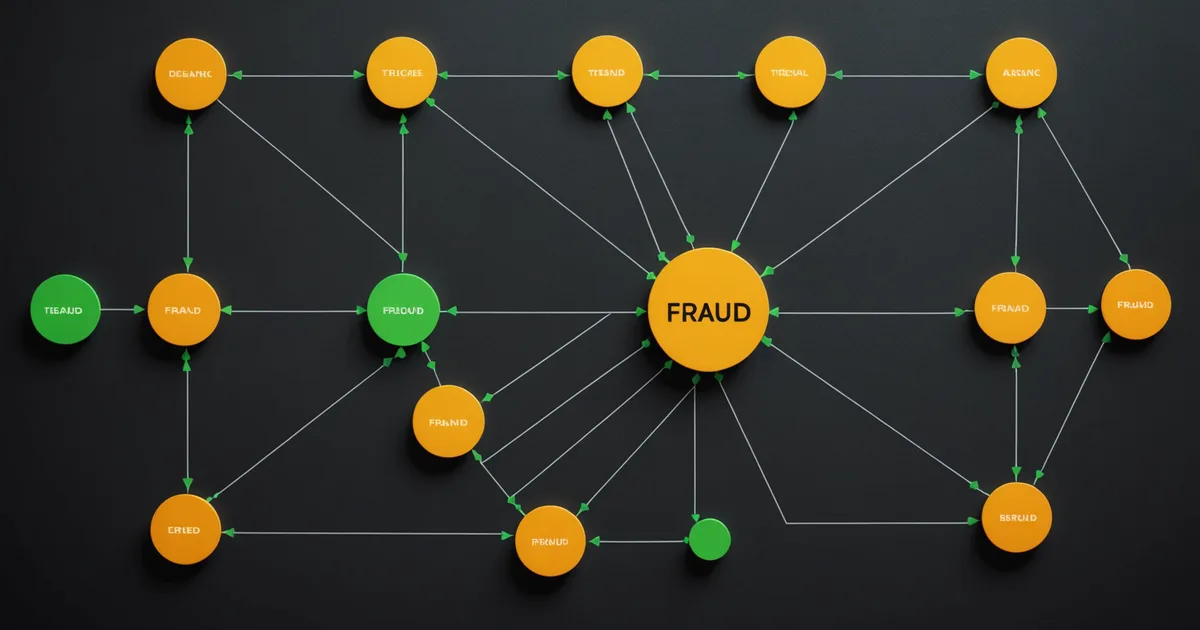
The faster approach is to use chargeback signals to update account-level and merchant-level risk priors without waiting for a full model retrain. When a confirmed fraud chargeback comes back on account A, immediately update account A's risk profile and elevate the base risk prior on any accounts that share device fingerprint, IP subnet, or behavioral pattern similarity with account A. This is not a model retrain: it is a targeted prior update that propagates the fraud signal to related entities in near-real time, typically within hours of chargeback confirmation.
The second approach is what Fraudpulsar's chargeback correlation feed implements. The confirmed chargeback triggers an immediate update to the account's behavioral risk profile and a similarity search across the active account population. Any account that exhibits meaningful feature similarity to the confirmed fraud account gets a temporary elevated risk prior that feeds into their next transaction score.
Merchant clustering: the signal most teams miss
Individual chargeback events are useful. But the pattern that often reveals more about an attack's structure is the merchant clustering signal: which merchants appear repeatedly in confirmed fraud chargebacks, and what is the temporal clustering of those chargebacks?
A card-testing operation or a compromised card ring will typically target a set of merchants that share properties: similar authorization response times, similar CVC/AVS check behavior, similar 3DS implementation. When confirmed fraud chargebacks cluster on a specific set of merchant IDs or merchant categories over a short window, that is a signal that those merchants are being used as probes or as the cashout point for the attack.
Feeding this back into the risk model as a merchant-level elevated risk signal means that the next transaction at merchant X, even from an account that has not yet been confirmed as compromised, will carry a higher base risk score because of the merchant's recent fraud chargeback density. This is a valuable predictive signal that is entirely orthogonal to the account-level behavioral model and only accessible if you have wired the chargeback data back in.
Structuring the feedback pipeline
The practical implementation of a chargeback feedback loop has a few components:
First, a chargeback intake process that classifies reason codes, separates first-party from third-party fraud, and strips out legitimate disputes. This is often partly manual for edge cases: reason codes alone do not always give you clean separation.
Second, a labeled event store: a database that links the confirmed chargeback back to the original transaction event, including the risk score that was assigned at transaction time. This linkage lets you compute the model's false negative rate and the feature distribution of transactions the model scored too low. Without this, you cannot do targeted improvement.
Third, a propagation step that updates account-level and merchant-level risk priors based on confirmed labels, without waiting for a full model retrain. How frequently this runs depends on your chargeback volume: daily is typical for most growing platforms, hourly is better if your volume justifies the pipeline complexity.
Fourth, a model evaluation process that reviews precision and recall on each cohort of confirmed labels: did the model score these fraud transactions high, medium, or low? What features were most predictive of the false negatives (transactions the model missed)? This evaluation drives the longer-cycle model update decisions.
The sample size constraint on growing platforms
One honest caveat: chargeback data is only useful as a training signal when you have enough of it. A platform processing a few thousand transactions per month and seeing 10-20 fraud chargebacks over 90 days does not have enough labeled examples to meaningfully retrain a behavioral model. At that scale, chargeback data is more useful for manual pattern review than for automated retraining.
We are not saying chargeback feedback loops are only for large platforms. We are saying that at low transaction volumes, the most valuable use of chargeback data is qualitative: read the confirmed fraud transactions, understand what the attack looked like, manually adjust model weights or rule thresholds based on what you observed. Automated retraining at low sample counts is more likely to overfit to noise than to genuinely improve the model.
The threshold where automated chargeback-driven updates become net positive versus net negative for model quality is roughly in the range of 50 or more confirmed fraud labels per month. Below that, manual review and targeted prior adjustments are the better approach. Above that, an automated pipeline starts paying off in detection quality.
The data exists. Every platform generating chargebacks has labeled fraud examples sitting in their dispute queue. Most of them are not using it to improve their detection. That is a gap worth closing.